1 Which of the Following Is True of Cooperative Scheduling
Which of the following is true of cooperative scheduling. Which of the following is the reason for business failure _____.

Cooperative Vs Preemptive A Quest To Maximize Concurrency Power By Bobby Priambodo Traveloka Engineering Medium
A process switches from the running state to the ready state when an interrupt occurs.
. B A process keeps the CPU until it releases the CPU either by terminating or by switching to the waiting state. The disadvantage of cooperative scheduling is that the process can choose to never stop execution possibly because of a bug generating some kind of infinite loop and therefore nothing else can ever run. In the following cases non preemptive scheduling occurs.
Process Arrival Time Burst Time P1 00 P2 20 P3 40 P4 50 For FCFS job scheduling the average waiting time is _____. Cooperative scheduling is the scheduling where the presently running process voluntarily stop executing to enable another different process to run. A process switches from the running state to the ready state when an interrupt occurs.
The operating system implements a shortest remaining time first scheduling algorithm. D A process switches from the running state to the ready state when an interrupt occurs. -It requires a timer-A process keeps the CPU until it releases the CPU either by terminating or by switching to the waiting state-It incurs a cost associated with access to shared data-A process switches from the running state to the ready state when an interrupt occurs.
As already mentioned in the OP cooperative scheduling is especially applicable to run event-driven systems of cooperating state machines. This section focuses on MultiThreading in Operating System. A novel Tabu search algorithm TSA-based operator is introduced in both the local search and mutation stage which.
Which of the following is true of cooperative scheduling. Up to 10 cash back Considering the low flexibility and efficiency of the scheduling problem an improved multi-objective immune algorithm with non-dominated neighbor-based selection and Tabu search NNITSA is proposed. D A process switches from the running state to the ready state when an interrupt occurs.
Which of the following is true of cooperative scheduling. Lets take a look at some of the key components. A when a process switches from the running state to the waiting state B when a process switches from the running state to the ready state C when a process switches from the waiting state to the ready state D none of the above Ans.
D A process switches from the running state to the ready state when an interrupt occurs. In that case you dont even need explicit yield or a context switch. The former refers to the long-range and the latter refers to the medium-range.
7 2 1 4 A 425 B 475 C 375 D 5. Which of the following is true of cooperative scheduling. A It requires a timer.
Considering that the context switches at time zero and at the end are not counted the number of context switches. CPU utilization Response time Turnaround time. B A process keeps the CPU until it releases the CPU either by.
B A process keeps the CPU until it releases the CPU either by terminating or by switching to the waiting state. The ready queue is a queue of tasks which. Assume the following processes each with their arrival time and burst time.
Can be used stand-alone or in conjunction with a messaging system such as the ETLs message router or FSM as the. C It incurs a cost associated with access to shared data. Three CPU intensive processes requires 10 20 and 30 time units and arrive at times 0 2 and 6 respectively.
Which of the following is true of cooperative scheduling. B A process keeps the CPU until it releases the CPU either by terminating or by A It requires a timer. C It incurs a cost associated with access to shared data.
In a way that the positioning uncertainty is minimized. The former refers to the long-range and the latter refers to the short-range. Each state machine naturally processes events in a run-to-completion RTC fashion and then it returns to the event loop.
Round-robin RR scheduling degenerates to first-come-first-served FCFS scheduling if. Which of the following is true of cooperative scheduling. The use of informal networks by entrepreneurs to gather information is known.
B A process keeps the CPU until it releases the CPU either by terminating or by switching to the waiting state. It requires a timer. It incurs a cost associated with access to shared data.
It incurs a cost associated with access to shared data. These Multiple Choice Questions MCQ should be practiced to improve the Operating System skills required for various interviews campus interview walk-in interview company interview placements entrance exams and other. Which of the following is true of cooperative scheduling.
A process keeps the CPU until it releases the CPU either by terminating or by switching to the waiting state. Which of the following is true of cooperative scheduling. Which of the following circumstances can cooperative scheduling take place.
D A process switches from the running state to the ready state when an interrupt occurs. C It incurs a cost associated with access to shared data. Question 2 1 point In.
It requires a timer. A process keeps the CPU until it releases the CPU either by terminating or by switching to the waiting state. It requires a timer.
Which of the following is true of cooperative scheduling. True False Question 3 1 point is the number of processes that are completed per unit time. When a process switches from the running state to the ready state When a process goes from the running state to the waiting state When a process terminates Both b and c above.
It incurs cost associated with access to shared data. The former is concerned with allocating available resources and the latter with the acquisition of resources. For use when a complex OS or RTOS is overkill.
Lack of market research. The following code runs modified versions of these functions using a simple cooperative scheduler. Aggregate planning differs from scheduling in that.
A process keeps the CPU until it releases the CPU either by terminating or by switching to the waiting state. It requires a timer. Which of the following is true of cooperative scheduling.
Another approach for cost management in CL is via measurement scheduling in which robots get restricted to take only certain number of relative measurements but they have to choose their landmark robots 1 1 1 A landmark robot is a robot that another robot takes measurement from. Which of the following is true of cooperative non-preemptive scheduling. A It requires a timer.
A lightweight cooperative multi-tasking scheduler. A process switches from the running state to the ready state when an interrupt occurs. A It requires a timer.
C It incurs a cost associated with access to shared data. A process keeps the CPU until it releases the CPU either by terminating or by switching to the waiting state. Operating System MCQ - Multithreading.
A process keeps the CPU until it releases the CPU either by terminating or by switching to the waiting state.

Preemptive Scheduling An Overview Sciencedirect Topics
Operations Supply Chain Management Mcq
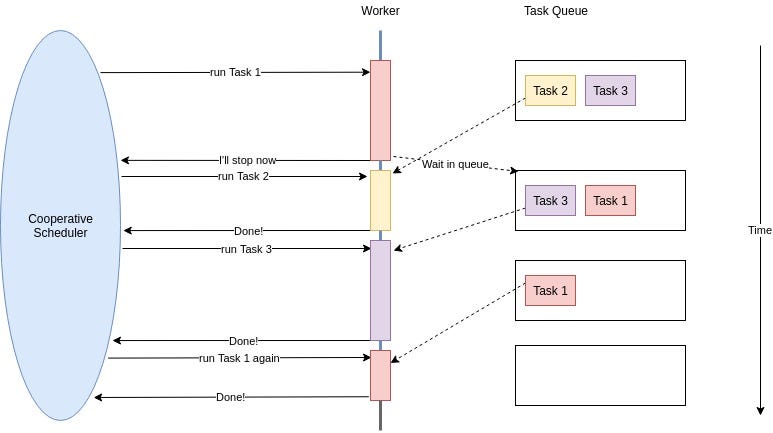
Cooperative Vs Preemptive A Quest To Maximize Concurrency Power By Bobby Priambodo Traveloka Engineering Medium


Comments
Post a Comment